Research
Research
Applied research on integrity, governance and decision intelligence, designed to be usable by public institutions.
Research agenda map
Four questions, one evidence programme
Select an axis to trace the work that answers it.
- Procurement fraud detection with latent classes
- Evasion as a signal of state capture
- Stop counting activity, start measuring consequences
- Synthetic control: Lava Jato and governance indicators
- Anti-corruption reforms and education outcomes
- Corruption, trust and Lava Jato in Brazil and Mexico
- Policy brief: Lava Jato, corruption and trust
Browse the evidence trail
Uses the Synthetic Control Method to examine associations between Operation Lava Jato and Brazil’s Worldwide Governance Indicators.
Open DOI ↗Working paper · 2026
Evasion as a Signal: Executive Responsiveness to Parliamentary Oversight Requests as a Diagnostic Tool for State Capture
A working-paper proposal treating substantive evasion as a diagnostic signal of institutional risk.
Thesis or dissertation · 2021
Assessing the Potential for Detecting Fraud in Brazilian Public Procurement Using Latent Class Analysis
Assesses the potential to identify procurement-risk patterns in Brazilian public procurement using latent class analysis.
Institutional repository ↗Thesis or dissertation · 2020
Applying Structural Equation Modeling to Analyze the Mutual Causality between Corruption and Trust and the Impact of Lava Jato
Models the relationships among corruption, institutional trust and Operation Lava Jato in Brazil and Mexico.
Conference presentation · 2025
Anti-Corruption Reforms in Brazil, Kenya, and Rwanda: Assessing the Impact on Education Outcomes (SDG 4)
Conference research on anti-corruption reforms and education outcomes in Brazil, Kenya and Rwanda.
Article · 2026
The Weakest Link in Government AI Is Oversight
Explains why oversight is essential to responsible AI in government, using Brazil as an institutional case study.
Read on LinkedIn ↗Examines evidence on how whistleblowing, internal audit and risk indicators help detect procurement fraud.
Read on LinkedIn ↗Article · 2026
Who Controls the AI That Does Control?
Sets out the controls needed when AI systems influence public audit, investigation and oversight decisions.
Read on LinkedIn ↗Article · 2026
AI and Democracy: Beyond Disinformation
Connects AI and democracy through institutions, controls and the ability to contest public decisions.
Read on LinkedIn ↗Article · 2026
Public Projects Fail at the Last Mile
Shows why public projects fail at delivery and which management routines connect design, decision and execution.
Read on LinkedIn ↗How I work
What I do
Integrity and procurement analytics. Latent Class Analysis and red-flag models that turn procurement microdata into audit priorities, distinguishing risk signals from evidence strength so that a flag never reads as a verdict.
Causal inference for institutional reform. Synthetic Control, Difference-in-Differences and Regression Discontinuity applied to anti-corruption reforms, governance indicators and development outcomes.
Oversight analytics. Text-as-data and LLM pipelines that measure whether the Executive branch substantively answers legislative oversight, rather than merely replying on time.
Governance systems. Strategy, instrumentation and monitoring routines that connect objectives to decisions in public organizations.
Core methods
Latent Class Analysis · Synthetic Control Method · Difference-in-Differences · Regression Discontinuity Design · Structural Equation Modeling · Text-as-data and structural topic modeling · Machine learning red flags
Tools: Python · Stata · R · Mplus · Power BI · Airtable · LLM/API workflows
Interactive portfolio
Explore the work by public problem
Choose an axis to see the problem, method and concrete output behind the work.
Make procurement risk visible
- Problem
- How can oversight teams triage large portfolios without treating a risk flag as proof?
- Method
- Latent classes, reproducible indicators and explicit uncertainty controls.
- Output
- Radar Aberto and its human-verification trail.
Measure the quality of government replies
- Problem
- Do formal replies actually answer legislators’ questions?
- Method
- Text-as-data, five audit dimensions and human validation.
- Output
- An AI-assisted oversight audit system.
Test whether promises can be monitored
- Problem
- Do government plans define delivery, accountability and evidence?
- Method
- Document analysis with a transparent governance rubric.
- Output
- A public explorer and companion report.
Test whether a reform changed outcomes
- Problem
- What would plausibly have happened without the intervention?
- Method
- Synthetic Control Method and robustness checks.
- Output
- Peer-reviewed research on governance outcomes.
Policy briefs
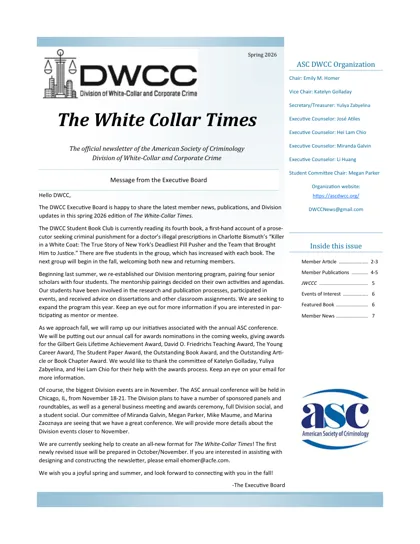
An essay on anti-corruption oversight organized around measurable consequences rather than activity counts.
Download article (PDF, English) ↗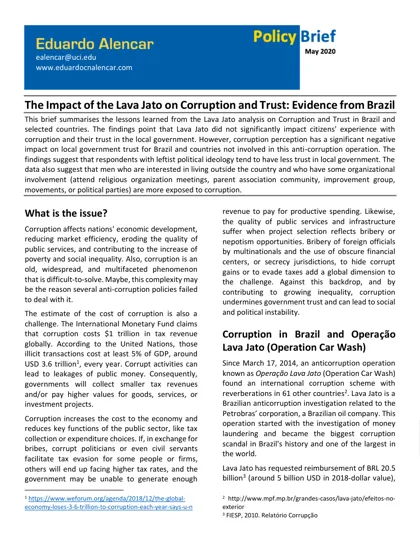
Policy brief · 2020
The Impact of Lava Jato on Corruption and Trust: Evidence from Brazil
A policy brief on the effects of Lava Jato on corruption and institutional trust.
Download policy brief (PDF, English) ↗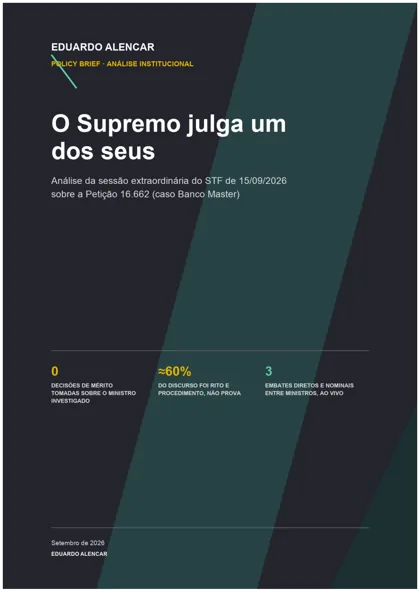
Policy brief · 2026
O Supremo julga um dos seus
An institutional analysis of the Brazilian Supreme Court’s extraordinary session of 15 September 2026 concerning Petition 16,662.
Download policy brief (PDF, Portuguese) ↗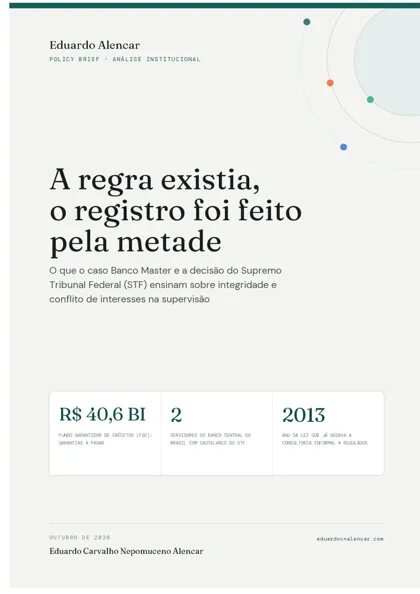
Policy brief · 2026
A regra existia, o registro foi feito pela metade
Examines the Banco Master case through the Brazilian Supreme Court’s precautionary decision, conflict-of-interest law and the Central Bank’s meeting-record rules, and recommends a mandatory, auditable record of substantive contacts between supervisors and supervised institutions.
Download policy brief (PDF, Portuguese) ↗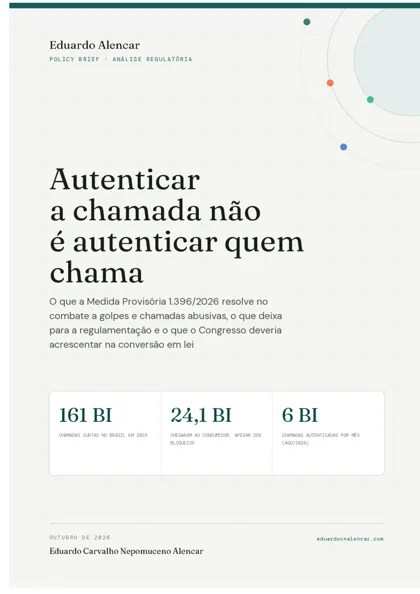
Policy brief · 2026
Autenticar a chamada não é autenticar quem chama
Analyses Brazil’s Provisional Measure 1,396/2026 (call authentication, branded caller ID and blocking of mass dialers) against a 10-criterion rubric and proposes three additions for its conversion into law.
Download policy brief (PDF, Portuguese) ↗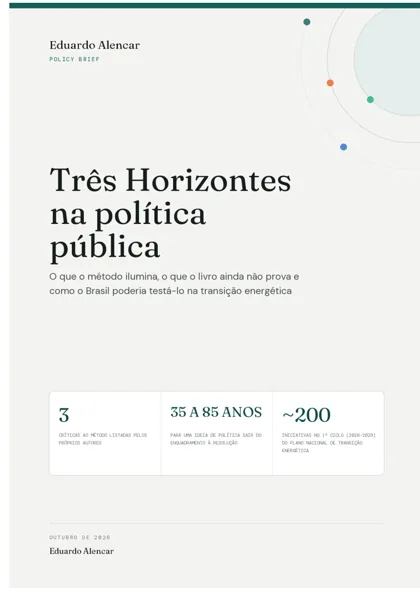
Policy brief · 2026
Três Horizontes na política pública
Analyses the book The Three Horizons Approach (Palgrave, 2026), assesses the method’s usefulness for public policy and identifies gaps in evidence and in application to Brazil. Proposes testing the method in Brazil’s energy transition, with five recommendations naming actor, condition and milestone.
Download policy brief (PDF, Portuguese) ↗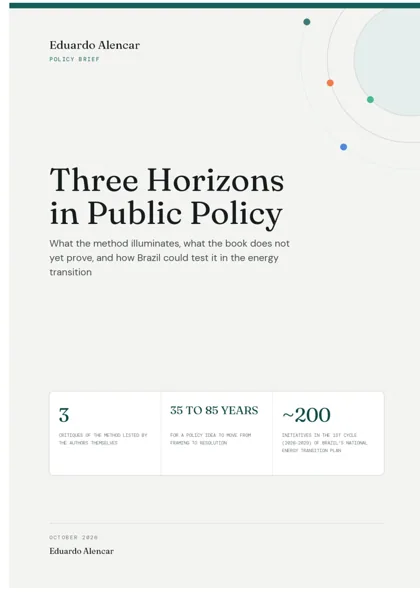
Policy brief · 2026
Three Horizons in Public Policy
Analyses the book The Three Horizons Approach (Palgrave, 2026), assesses the method’s usefulness for public policy and identifies gaps in evidence and in application to Brazil. Proposes testing the method in Brazil’s energy transition, with five recommendations naming actor, condition and milestone.
Download policy brief (PDF, English) ↗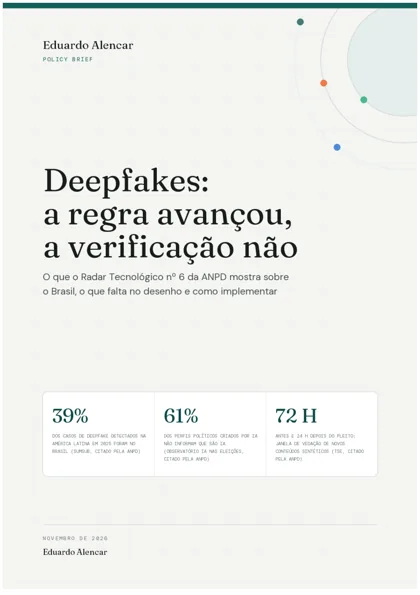
Policy brief · 2026
Deepfakes: a regra avançou, a verificação não
Starts from the Technology Radar no. 6 of Brazil’s data protection authority (ANPD) on deepfakes and checks the Brazilian norms it cites against the official texts. Shows that responsibility moved from the author to the provider and that verification of authenticity does not yet support enforcement. Proposes critical success factors, collaborative gap analysis and five recommendations.
Download policy brief (PDF, Portuguese) ↗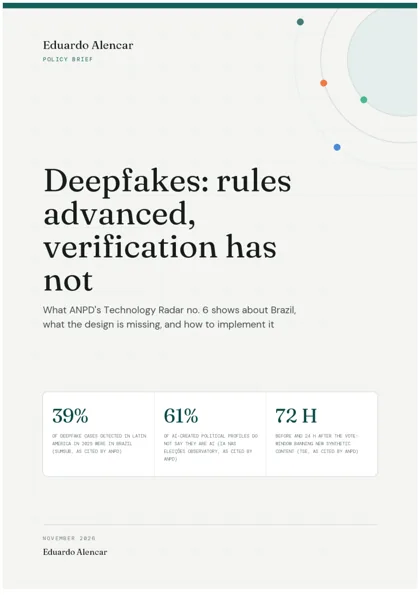
Policy brief · 2026
Deepfakes: rules advanced, verification has not
Starts from the Technology Radar no. 6 of Brazil’s data protection authority (ANPD) on deepfakes and checks the Brazilian norms it cites against the official texts. Shows that responsibility moved from the author to the provider and that verification of authenticity does not yet support enforcement. Proposes critical success factors, collaborative gap analysis and five recommendations.
Download policy brief (PDF, English) ↗Research agenda
Integrity and procurement analytics. Identifying latent supplier typologies and risk patterns in public procurement to guide audit prioritization when fraud labels are sparse.
Causal inference for reforms. Estimating the effect of anti-corruption and institutional reforms on governance and development outcomes using counterfactual designs.
Corruption and trust. Modeling the mutual causality between corruption experience, corruption perception and institutional confidence.
Oversight analytics. Measuring legislative attention and executive responsiveness through text-as-data analysis of parliamentary information requests.
Peer-reviewed publication
Alencar, E. C. N., & Jackson-Green, B. (2021). Applying Synthetic Control Method to estimate the impact of the Lava Jato operation on the Worldwide Governance Indicators in Brazil. Journal of White-Collar and Corporate Crime. DOI: 10.1177/2631309X211017874
Articles and newsletters
Alencar, E. C. N. (2026, Spring). Evidence-based anti-corruption oversight: stop counting activity, start measuring consequences. The White Collar Times, official newsletter of the American Society of Criminology Division of White-Collar and Corporate Crime.
Working papers and work in preparation
- Evasion as a Signal: Executive Responsiveness to Parliamentary Oversight Requests as a Diagnostic Tool for State Capture. Working paper proposal for a Journal of Financial Crime special issue.
- Latent Supplier Typologies and Procurement Fraud Risk: Evidence from Brazilian Federal Procurement Microdata. In preparation, Fraud Research Group collaboration track.
- Collusion detection in public procurement: integrating Latent Class Analysis and machine-learning red flags. In preparation.
- Open Innovation for Sustainable Development Goals (Nova Science Publishers). Chapter proposal accepted; chapter in preparation.
Conference papers and presentations
Accepted, forthcoming
Presented
- Formal Replies, Substantive Evasion. American Society of Criminology Annual Meeting, Chicago, November 2026.
- Digital Finance and Cyber Risk Oversight. American Society of Criminology Annual Meeting, Chicago, November 2026.
- The AI-Powered Parliamentary Oversight Auditing System (with Arthur Leite). Extended abstract accepted 20 July 2026; XIV Research and Extension Conference, CEFOR, Chamber of Deputies, 3–4 December 2026.
- Assessing the Impact of Anti-Corruption Reforms on Governance in Latin America: A Synthetic Control Analysis Including the United States, Mexico, Brazil, and Understudied Countries. 7th Conference of Academia against Corruption in the Americas, Bogotá, 21–23 May 2025.
- Anti-corruption reforms in Brazil, Kenya and Rwanda: assessing the impact on education outcomes (SDG 4). American Society of Criminology Annual Meeting, Washington DC, November 2025.
- Bridging Digital Transformation and Sustainability: overcoming governance challenges for green policy implementation. American Society of Criminology Annual Meeting, Washington DC, November 2025.
- Detecting fraud in price registration systems. 50th National Meeting of Economics (ANPEC), Fortaleza, 2022.
- Allaire, M., & Alencar, E. (2018). Trends in water rate structures to encourage conservation: evidence from California. AGU Fall Meeting, Washington DC.
Theses and dissertations
- PhD dissertation (University of California, Irvine, 2021; degree conferred 18 March 2022). Assessing the potential for detecting fraud in Brazilian public procurement using Latent Class Analysis.
- MA thesis (University of California, Irvine, 2020). Applying Structural Equation Modeling to analyze the mutual causality between corruption and trust and the impact of Lava Jato: evidence from Brazil and Mexico.
Policy and practice outputs
- Governança em Tempo Real: como o Brasil pode parar de fingir que governa. Book, Editora JusPodivm, 2026. ISBN 978-85-442-7915-1.
- The rule existed, the record was only half kept. What the Banco Master case and the Brazilian Supreme Court’s precautionary decision of 3 March 2026 show about integrity and conflict of interest in banking supervision, with a recommendation for a mandatory, auditable record of substantive contacts between supervisors and supervised institutions. Policy brief (in Portuguese), 2026. DOI: 10.5281/zenodo.23307256.
- Authenticating the call is not authenticating the caller. Analysis of Brazil’s Provisional Measure 1,396/2026, which turns call authentication, branded caller ID with company name and logo, and the blocking of mass dialers into law. It scores the text against a 10-criterion rubric and proposes three additions for the conversion into law: identity verification for the name-and-logo database, rules for calls coming from abroad, and a public indicator dashboard with an impact evaluation. Policy brief (in Portuguese), 2026. DOI: 10.5281/zenodo.23404841.
- The Supreme Court judges one of its own. Analysis of the Brazilian Supreme Court's extraordinary session of 15 September 2026 on Petition 16,662 (Banco Master case), examining whether the Court live-tested its own self-adjudication mechanism, over nearly eight hours, when the person under investigation is one of the Constitution's guardians. Policy brief, 2026.
- From administrative burden to risk-based regulation: latent class analysis and regulatory discontinuities in Latin American and Caribbean public procurement. IDB technical concept note, 2026 (in Spanish).
- Principais achados relacionados aos desembolsos de convênios e patrocínios da Itaipu Binacional. Parliamentary Front for Oversight, Integrity and Transparency (FIT), 2 April 2025.
- The impact of Lava Jato on corruption and trust: evidence from Brazil. Policy brief, 2020.
- Caderno Vozes da Classe Média: Classe Média e Emprego Assalariado. Secretariat of Strategic Affairs, 2013.
- Gestão de pessoas aplicada ao coaching, in Coaching e Mentoring: Foco na Excelência. Sermais, 2014.
- Política industrial, acompanhamento e análise, issues 21, 22, 23 and 24. Institute for Applied Economic Research (Ipea), 2003–2004.
Profiles
Google Scholar · ORCID · LinkedIn · YouTube